4DAnything
Generalizable Feed-Forward 4D Reconstruction In-The-Wild
Carnegie Mellon University
*Equal contribution
We present 4DAnything, a feed-forward generative model that reconstructs complete 4D object geometry, appearance, deformation, and camera-space transformation from casually captured monocular videos. While optimization-based methods can reconstruct dynamic objects from real-world videos, they require costly per-sequence optimization; conversely, feed-forward alternatives enable efficient inference, but learn only from synthetic 4D assets and do not recover the object's camera-space motion, limiting their robustness on real videos. To bridge this gap, 4DAnything adapts a pretrained single-image 3D generative model to video by introducing cross-frame information sharing during generation and decoding to reason about the complete object and its motion, and extends data-driven training to real-world videos reconstructed offline by test-time optimization. First, we preserve the pretrained 3D prior knowledge and reuse the model's self-attention to attend across frames, so that per-frame shape, appearance, and camera-space transformation stay coherent over time and regions visible in one frame inform those occluded in others. Second, the pretrained decoder is adapted to aggregate per-frame latents into a single set of canonical Gaussians and deformations, producing one consistent object with geometry and appearance correspondence across the video. Finally, to learn from diverse real-world data, we run test-time optimization offline to obtain large scale 4D pseudo-ground truth from videos in-the-wild, and use online direct preference optimization to score 4DAnything's own samples, reducing errors inherited from the pseudo-ground truth. Our method demonstrates state-of-the-art reconstruction performance on diverse sequences with complex motion, occlusions, and scene clutter, outperforming prior work on both synthetic and in-the-wild benchmarks.
Pick a scene below to explore its composition with complete 4D reconstructions. Drag to orbit; scroll to zoom.
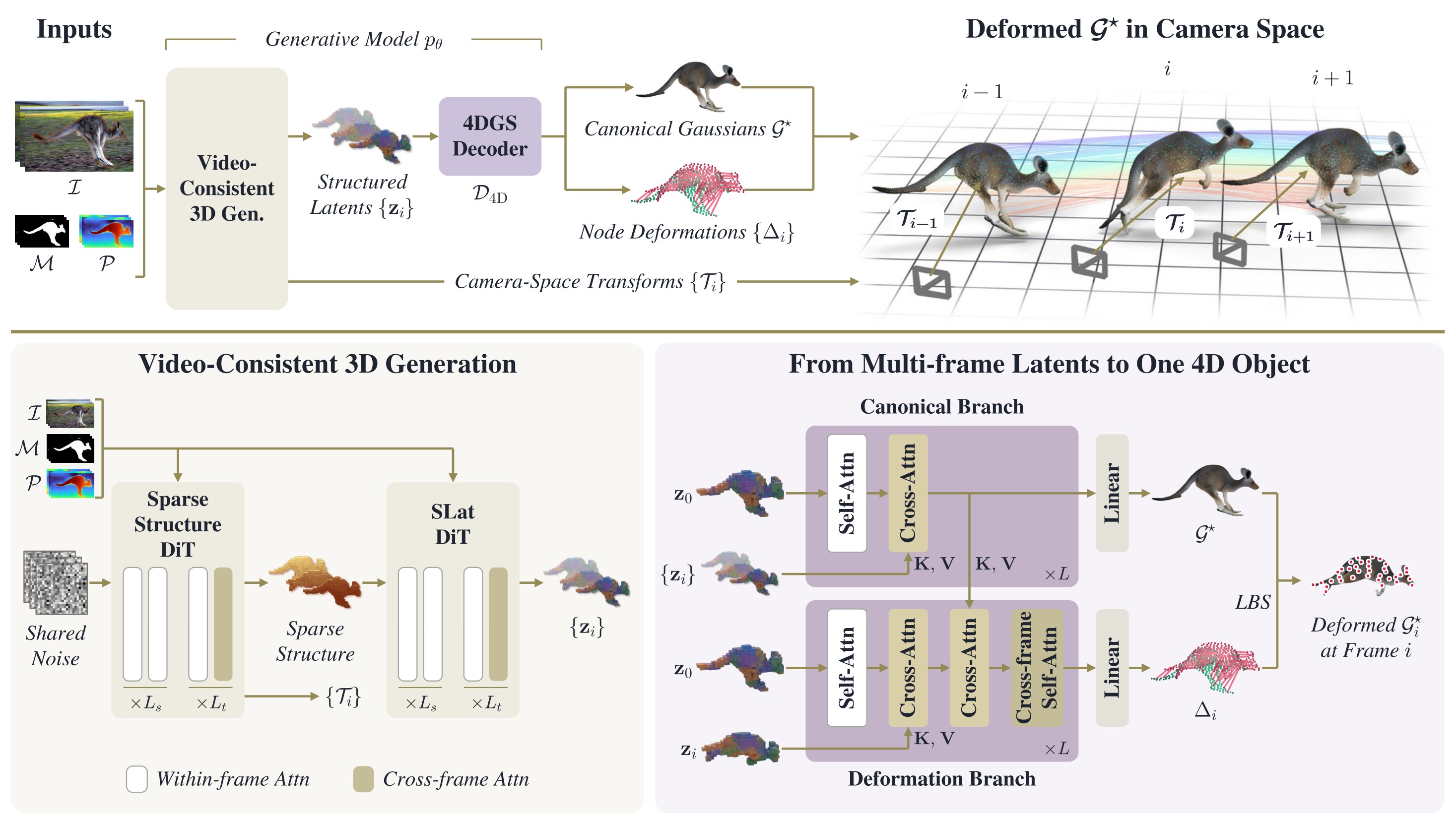
Given a video \(\mathcal{I}\) with object masks \(\mathcal{M}\) and pointmaps \(\mathcal{P}\), our generative model \(p_\theta\) predicts a 4D object in a single forward pass. A pretrained image-to-3D backbone is adapted into a video-to-4D generation model by inserting new self-attention layers into its DiTs and modifying them to attend across frames. A 4DGS decoder then merges the per-frame latents into one set of canonical Gaussians \(\mathcal{G}^\star\) and deformations, giving dense correspondence. Per-frame camera-space transformations \(\mathcal{T}_i\) can then place the reconstruction in camera space. Combined with an off-the-shelf geometry estimation model that reconstructs the camera poses and the scene, we can place the complete 4D object into the reconstructed 3D scene. We train on real videos with large scale 4D pseudo-ground truth reconstructions from data in-the-wild and post-train \(p_\theta\) with an LLM verifier to further enhance multi-view consistency as well as geometry and appearance quality.
Comparison of 4DAnything to feedforward and optimization-based baselines. Drag to rotate; slide ⇔ to compare.
@article{chang20264danything,
  author  = {Chang, Nathalie Claire and Litman, Yehonathan and Ma, Xiaoxuan and
             Ugrinovic, Nicol{\'a}s and De la Torre, Fernando and Kitani, Kris and
             Tulsiani, Shubham},
  title   = {{4DAnything}: Generalizable Feed-Forward {4D} Reconstruction In-The-Wild},
  journal = {arXiv preprint arXiv:TODO},
  year    = {2026},
}

